Tuesday, December 7, 2010

tips for your drawing graffiti art

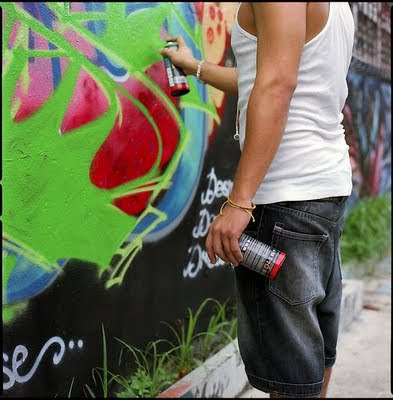
In particular the use of the bold style lettering is really distinctive to graffiti art. The images themselves will usually be hard hitting, and be painted in stark colours utilising strong shadows and outlines to add depth and definition. Images usually depict social or political issues close to the artist's heart.

tips for your drawing graffiti art

Before you start a piece of graffiti art, you should draw a small scale version of the large piece you want to create first, then when you begin your actual piece, its a simple task of just scaling up your graffiti sketch.

If you need ideas for a graffiti font to use, there are plenty of sites online that have examples for you to copy. For the outlines, use a fine marker pen. In order to produce a 3D effect, shade around the letters you've outlined with a different colour. Then use permanent markers to color in your letters.

Once you are ready to paint your sketch on to your larger canvas or wall, you need to draw a reference grid over your small drawing. Sketch a full size replica of the grid on to your wall or canvas that you are using for your scaled up graffiti piece. Use either chalk, charcoal or diluted paint to draw the large grid. To make marking the grid out easier, the simplest thing to do is to use a piece of string.

Use chalk or charcoal to transfer your small drawing on to you larger canvas. Use an aerosol can to paint the background in using diluted paint, keep the layer thin and allow it to dry before you start your colouring. When you've finished the outline and the background, it's time to add the colours and detail. Again use aerosols to add the colours. Start with the lightest colours first and the largest sections, and then move on to the detail and the smaller areas last.


When you've coloured your work in, you can add the fine definition with a brush to enhance the fine lines and borders around your figures and letters. You can preserve it for years to come with a thin layer of varnish.

These are all the steps you need to master if you want to paint impressive graffiti art.

Graffiti Breaks Free From Wall

The Hip-hop theatre pioneer Jonzi D explores the issue of whether graffiti really is an artform or merely vandalism. He directs a team of six of the UK's best break- dancers and body-poppers, who become "physical calligraphy" alongside specially commissioned graffiti "sculptures" and on-stage video animations.

The dancers, representing paints and colours, move within large, sculpted graffiti-style letters made of wood, steel and upholstery, all created by the British graffiti artist Prime, of Sculptural Graffiti. The dance theatre piece, set to a score by DJ Pogo that combines hip-hop break-beats and scratch patterns, charts the story of an obsessive graffiti writer.

"We're not trying to define whether graffiti art is a crime or not: we know that it is," Jonzi D says. "But it is also an artform. We are having a creative discussion on the vandalism and the criminality and the artistry of the form."

The graffiti artist is played by John Berkavitch, a performance poet and breakdancer who is also a graffiti artist. "Like a puppet master, he shapes the bodies of the dancers with an imaginary graffiti wand into images that come to life," Jonzi D says. "He is exorcising his personal and creative demons in the only way he knows how."

Since graduating from the London Contemporary Dance School in 1993, Jonzi D has dedicated himself to hip-hop theatre, creating Lyrikal Fearta in 1995 and Aeroplane Man in 1999. He was an associate artist at The Place, London, and has performed dance theatre all over the world. He is also the creator and host of Breakin' Convention, the annual hip-hop festival at Sadler's Wells in London.